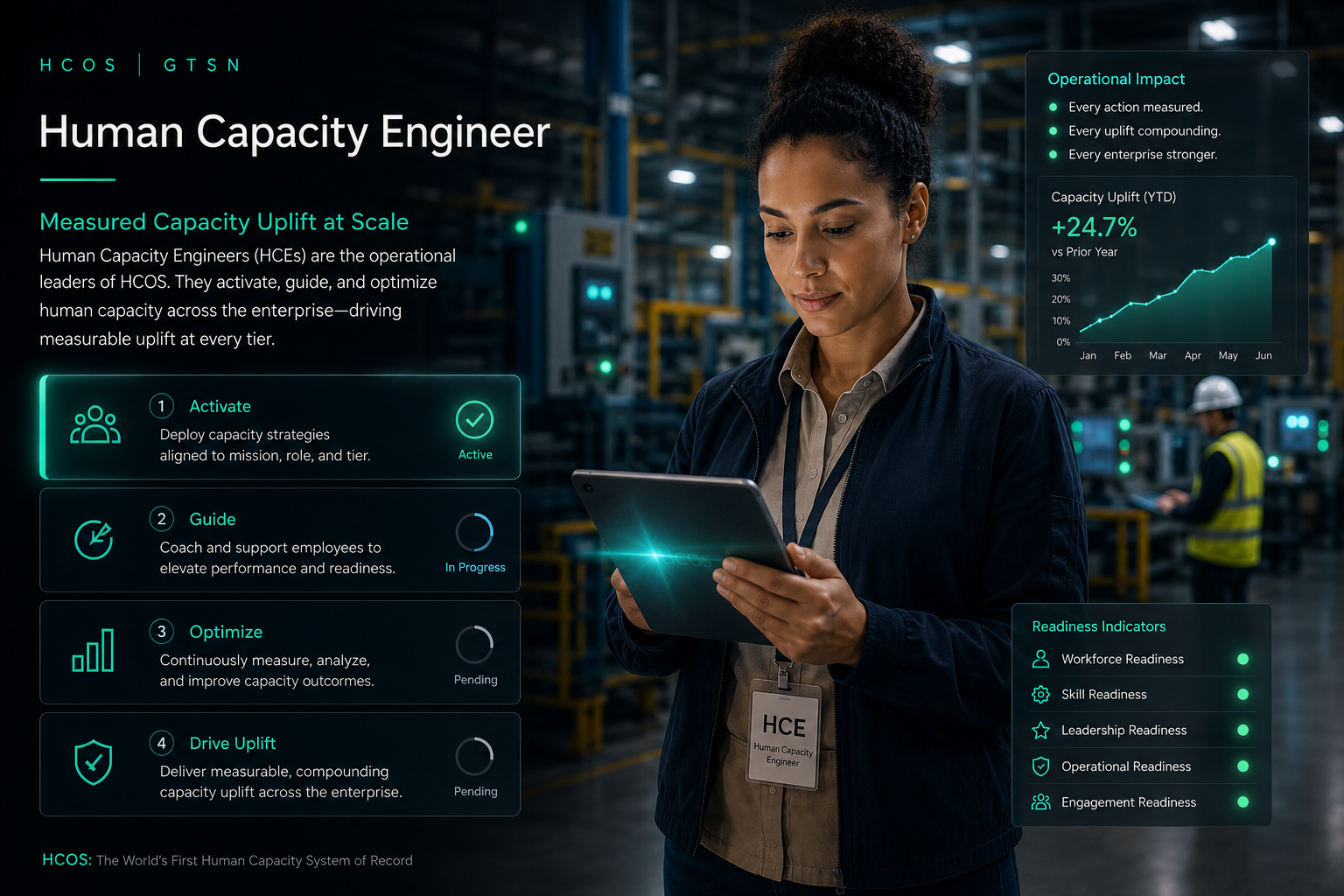
The World’s First Human-Capacity System of Record
Organizations already invest millions into workforce capacity through salaries, training, leadership development, and management. Yet much of the economic value embedded within that workforce remains difficult to systematically measure, govern, and recover.
HCOS™ introduces a workforce-governance layer designed to recover, compound, and scale the value already present inside the workforce, transforming human capacity into a measurable enterprise asset.
Performance Meets Purpose
with GTSN™
Two enterprises can employ the same number of people. However, they do not produce the same workforce value.
Without HCOS, human capacity remains largely unmanaged as an enterprise asset. Organizations can measure labor, performance, engagement, and cost, but they lack continuous infrastructure for governing the underlying capacity of every individual and measuring how that capacity changes over time.
HCOS changes that.
HCOS establishes the enterprise’s existing workforce value as a measurable baseline. From that zero point, the system continuously governs and measures readiness, behavioral discipline, Tier progression, leadership consistency, retention, productivity, and financial impact across the workforce.
As Tier 1 saturation increases, the enterprise can see exactly what changed, where it changed, and what economic value was created relative to where the workforce began.
Without HCOS
Workforce capacity remains fragmented across initiatives, managers, systems, and moments in time. Development is episodic. Progress is difficult to govern continuously. Additional human capacity can emerge without becoming a measurable, durable enterprise asset.
With HCOS
Every worker enters a continuous human-capacity governance system designed to develop, measure, and compound individual and enterprise value over time. The employee gains a long-term progression pathway. Leadership gains operating visibility. The enterprise gains an infrastructure for connecting workforce development to measurable operational and financial outcomes.
This creates a new competitive variable: governed human capacity.
As HCOS is validated and deployed at scale, enterprises operating the system build a structurally different workforce-value profile from organizations that continue managing human capacity through fragmented programs and legacy systems.
The Competitive Consequence
HCOS turns human capacity into a governed, measurable, compounding enterprise asset.
Enterprises without HCOS continue losing workforce value they cannot systematically measure, recover, or compound. Enterprises with HCOS continuously develop stronger workers, retain more value, stabilize leadership, and convert workforce progression into measurable economic impact.
Once that advantage exists, HCOS is no longer optional infrastructure.
Enterprises that adopt it gain a compounding workforce advantage. Those that do not face an increasingly difficult reality:
How do you compete against a workforce whose capacity is continuously governed and compounded when yours is not?
HCOS establishes a new source of enterprise value, a competitive advantage that is extremely difficult to replicate and compounds enterprise value over time.
$10.1B – ROI per 10,000 employees over 20 years
$500M+ – Annual operational lift at 90% Tier 1™ saturation
3 Sectors – Oil, Gas & Energy • Manufacturing & Industrial Operations • Supply Chain & Logistics
1 System – Patent-pending GTSN™, exclusive to Global Trust Systems™ for two decades per partner
The Human-Capacity Balance Sheet
Introducing the Enterprise Reporting Layer for Human-Capacity Governance
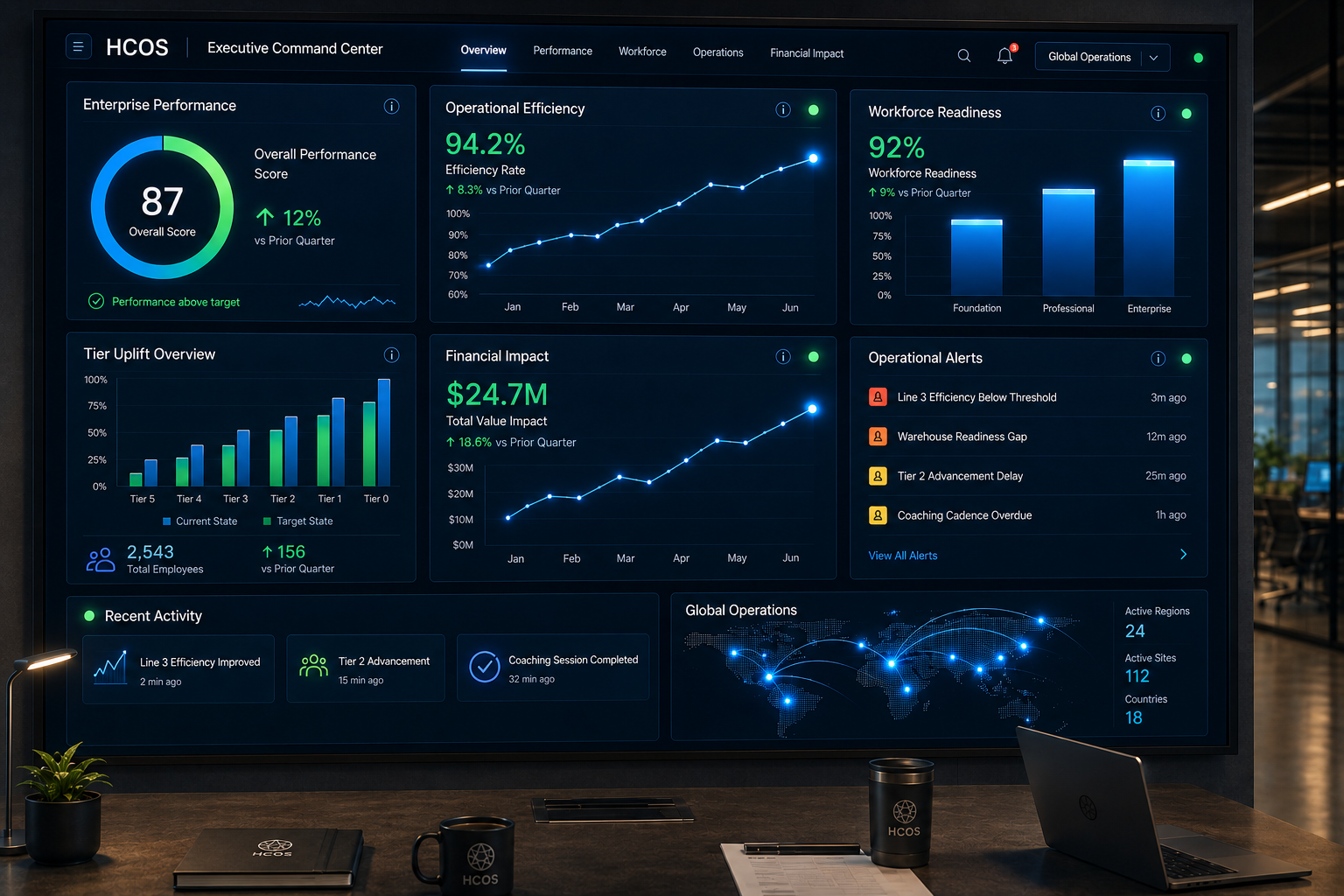
HCOS introduces the first Human-Capacity Balance Sheet (HCBS) — an enterprise reporting layer that measures workforce readiness, Tier distribution, leadership density, and operational stability.
Traditional organizations evaluate workforce performance through subjective assessments.
HCOS replaces this with measurable capacity signals, allowing executive leadership to observe the structural drivers of workforce performance in real time.
Enterprises gain visibility into:
• Tier distribution across teams
• readiness stability across operational cycles
• leadership maturity density
• productivity correlation with readiness signals
• predictive workforce volatility indicators
This reporting structure allows organizations to manage human capacity with the same rigor applied to financial capital and operational systems.
HCOS Enterprise Integration Architecture
How HCOS Integrates with Existing Enterprise Systems
These infrastructure modules define how HCOS™ integrates into your organization’s operating layer:
Strategic Integration Layer
Maps enterprise roles, leadership cadence, and operational accountability into Tier-governed execution pathways.
Leadership Density Layer
Establishes Tier-1 leadership pathways that stabilize decision cadence across executive and management layers.
Operational Intelligence Layer
Integrates KPI visibility with readiness and Tier migration signals, transforming workforce capacity into board-level operational intelligence.
Continuity & Resilience Layer
Stabilizes workforce execution through readiness monitoring and Tier governance during high-scale operations.
Each infrastructure module operates as part of a cohesive HCOS™ ecosystem — infrastructure, not service.
Decades-Scale Architecture Built for Enterprise Continuity
HCOS operates as a structural layer governing workforce readiness, Tier progression, and leadership maturity across enterprise environments. By stabilizing human capacity at scale, HCOS converts workforce performance from a volatile variable into a predictable enterprise asset.
Tier-Aligned Capacity.
Architecture
Strategic Integration Acquisition Architecture
Role-layer mapping and Tier alignment that integrates workforce structure into a governed execution continuum — built for stability, not transactions.
Enterprise Capacity Governance
A structural governance layer that defines accountability, cadence, and performance visibility across workforce tiers — integrated into operations, not delivered as consulting.
Leadership Capacity Embedding
Tier 1 execution cadence for leaders: operational discipline, decision rhythm, and measurable capacity elevation that saturates across departments without redesign.
Resilience & Continuity Frameworks
Systems that anticipate drift, stabilize performance under scale pressure, and reinforce workforce continuity through Tier monitoring and readiness calibration.
Enterprise Capacity Uplift at Scale
Partner with Global Trust Systems to integrate Tier-based capacity governance into your enterprise operating structure, transforming workforce volatility into measurable, long-horizon performance stability.